
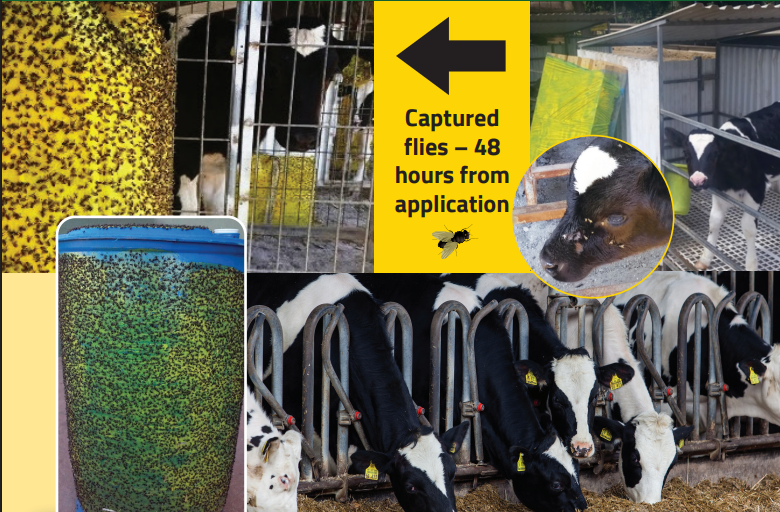
From livestock operations and food production facilities to greenhouses and commercial premises, flying insects are far more than a nuisance. Houseflies and other pest species can spread disease-causing pathogens, contaminate food, reduce livestock productivity and create significant operational challenges for businesses.
Traditionally, controlling these pests has relied heavily on chemical insecticides. While effective in some situations, these methods can raise concerns around environmental impact, resistance development and worker safety. Increasingly, industries are looking for solutions that are both effective and environmentally responsible.
Israeli companies are helping meet this challenge through innovative, non-chemical technologies that focus on attracting and trapping pests rather than poisoning them. Two examples are **Flybuster** and **Luxembourg Industries**, whose products demonstrate different but complementary approaches to sustainable insect control.
Flybuster: Using Nature to Break the Fly Life Cycle
Flybuster has developed an innovative trapping system that replaces conventional chemical fly control with a natural biological attractant. At the heart of the system is a fermented yeast-based bait produced from food-grade ingredients. Once mixed with water, the bait ferments and releases odours that mimic the organic matter naturally sought by flies. Rather than using insecticides or animal-protein attractants, the formulation is based on plant-derived ingredients and contains no toxins. Since it does not use animal proteins there is no risk of spreading animal diseases to new areas.
The bait is used in conjunction with a specially designed one-way trap. Flies are attracted inside but cannot escape. Female flies subsequently lay their eggs within the trap, interrupting the breeding cycle and helping to reduce future fly populations rather than simply eliminating adult insects.
The company emphasises that its bait contains no animal-source proteins, avoiding the potential introduction of foreign pathogens associated with some traditional protein-based fly attractants. The product is designed to provide an environmentally responsible solution suitable for livestock facilities, food production sites, recycling centres, hospitals, gardens and a range of other commercial environments.
Luxembourg Industries’ Amarillo: Harnessing Colour Instead of Chemicals
While Flybuster relies on scent, Luxembourg Industries takes advantage of another aspect of insect behaviour: vision.
Its “Amarillo” product is a water-based adhesive designed to create large sticky trapping surfaces. Many flying insect pests—including whiteflies, houseflies, thrips, fruit flies and fungus gnats—are naturally attracted to the colour yellow. Amarillo is applied to yellow plastic sheets or other smooth surfaces, creating durable sticky traps that capture insects as they land.
Because the product contains no pesticides or organic solvents, it provides growers with a non-toxic option for monitoring and reducing insect populations. The adhesive remains effective for months under greenhouse conditions and is designed to withstand rain and varying environmental conditions outdoors.
One practical advantage of Amarillo is its flexibility. It can be sprayed, brushed or rolled onto suitable surfaces, and when the adhesive becomes covered with insects, another layer can simply be applied, extending the working life of the trap. This makes it particularly well suited to integrated pest management (IPM) programs, where continuous monitoring and population suppression are preferred over repeated chemical applications.
Innovation Through Different Approaches
Although Flybuster and Amarillo employ very different technologies, they share a common philosophy: leveraging insect biology instead of relying on conventional pesticides.
Flybuster exploits flies’ attraction to fermenting organic material, while Amarillo capitalises on the visual attraction many pest species have to the colour yellow. Both solutions provide effective, environmentally conscious alternatives that can reduce reliance on chemical insecticides while supporting healthier agricultural and commercial environments.
Israeli Innovation for Sustainable Agriculture
As agriculture worldwide faces growing pressure to improve productivity while reducing environmental impacts, demand for smarter pest management continues to grow.
Israeli companies have long been recognised for developing practical solutions to complex agricultural challenges. Flybuster and Luxembourg Industries exemplify this tradition, demonstrating how scientific understanding of insect behaviour can produce highly effective, sustainable technologies.
Rather than fighting nature with increasingly intensive chemical inputs, these innovations work with natural insect behaviour—offering growers, livestock producers and commercial operators cleaner, safer and more sustainable options for managing one of agriculture’s oldest challenges.
Discover more from
Subscribe to get the latest posts sent to your email.
